FAQs

How do I clean Tekscan sensors?

Question: How do I clean Tekscan sensors?

Answer: You can wipe our sensors clean with alcohol or water.

Link to this FAQ

How fast does the developed color of Prescale fade and what is the best way to keep the measured Prescale from being deteriorated?

Question: How fast does the developed color of Prescale fade and what is the best way to keep the measured Prescale from being deteriorated?

Answer: Ultraviolet rays accelerate the fading process of the color. Therefore, please protect the Prescale from ultraviolet rays by keeping it in a file and storing the file in a cabinet. The color will gradually fade even when storing the film in this manner. It is recommended that you measure the pressure values with a pressure measurement system within 60 minutes of applying the pressure and that you keep the data in digital form for reference.

Link to this FAQ

How fast is the Prescale System's minimum measurable pressure application speed?

Question: How fast is the Prescale System's minimum measurable pressure application speed?

Answer: The minimum measurable pressure application speed is 1 msec. At faster rates, accurate data cannot be guaranteed since microcapsules and color-developing material would absorb the pressure. As for the slowest speed, there's no limit unless pressure is repeatedly applied.

Correlation between pressure and micro-capsules

Micro-capsules in varying sizes and wall strength are used for Prescale. The size of the micro-capsule and the strength of its wall correlate with pressure. Large micro-capsules and micro-capsules with thin walls are broken by low pressure and small micro-capsules and micro-capsules with thick walls are broken by high pressure. The size of individual micro-capsules varies but starts as small as several µm. Small micro-capsules are coated on the Prescale to measure high pressure, and large micro-capsules are coated on the Prescale to measure low pressure.

Correlation between color density and micro-capsules

The volume of color forming material in micro-capsules and color developing material determines the color density.

Link to this FAQ

What surface is best to use underneath a FlexiForce sensor?

Question: What surface is best to use underneath a FlexiForce™ sensor?

Answer: A flat, smooth surface is ideal.

Link to this FAQ

What is a puck/shim and do I need to use it?

Question: What is a puck/shim and do I need to use it?

Answer: A puck, otherwise known as a shim or load concentrator, is an object placed between the sensing area and load (like cheese between two pieces of bread) to ensure that the sensor captures 100% of the applied load if the contacting surface is larger than the sensor diameter and to reduce high pressure for point load applications. The applied pressure should be between 1 and 10,000 psi.  If the applied force is small, e.g. 30 grams, a puck should be used to reduce the area to achieve at least 1 psi. For applied loads that are high but have a very small area, a puck should be used to reduce psi to below 10,000. For best results, the loaded area or puck should be between 70% (a diameter of 0.263”, or area of 0.077in2 ) and 100% of the sensing area but can be reduced to achieve results as described above.  Plastic pucks are recommended, as they are pliable but will not deform.

Tekscan offers peel-and-stick delrin pucks for purchase at our online store.

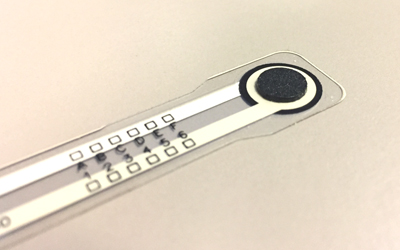
Example of a puck adhered to a FlexiForce A201 sensor.Example of a puck adhered to a FlexiForce A201 sensor.

Link to this FAQ

Is "110% of the maximum load" what a FlexiForce sensor can handle?

Question: Is "110% of the maximum load" what a FlexiForce™ sensor can handle?

Answer: Typically, the answer is "no". The mechanical properties of the different force range sensors are very similar. The polymer materials of which these sensors are composed will start to deform plastically around 10,000 psi.

Link to this FAQ

Why do I need to calibrate a FlexiForce sensor?

Question: Why do I need to calibrate a FlexiForce™ sensor?

Answer: Calibration is a very important step. There is a slight variance between sensors, which calibration corrects. When performed in an environment similar to that of the test environment, calibration helps improve repeatability and neutralize drift.

Refer to our Quick Start Calibration Guide for more details.

Link to this FAQ

What is the maximum period of not using a FlexiForce sensor before you have to recondition it?

Question: What is the maximum period of not using a FlexiForce™ sensor before you have to recondition it?

Answer: You should recondition the sensor if you haven't used it in 24 hours.  Please note that the more you recondition it, the better it should perform.

Link to this FAQ

How much error is induced if a FlexiForce sensor is not conditioned?

Question: How much error is induced if a FlexiForce™ sensor is not conditioned?

Answer: The error could be greater than the standard ±5% error if not conditioned prior to testing. You should always condition the sensor prior to use.

Link to this FAQ

Why do you need to condition a FlexiForce sensor?

Question: Why do you need to condition a FlexiForce™ sensor?

Answer: You should always condition the sensor prior to testing because the sensor's output changes the first few times it is loaded. By loading the sensor before your calibration, you will ensure that the sensor is producing repeatable results for your calibration and testing. It will also produce a repeatable drift curve. You can condition the sensor by loading it at 110% of your maximum load for a few cycles.

Refer to our Quick-Start Calibration Guide for more details.

Link to this FAQ