FAQs

How is the F-Scan64 system different from the F-Scan System?

The main difference between the F-Scan64 and F-Scan systems lies in the micro-sized electronics.  The F-Scan64 electronics allows for a completely cord-free Bluetooth connection system with a quick setup time of three minutes or less. Also, users do not need to trim sensors.  The number “64” refers to the number of sensing elements in the sensor regardless of the sensor size.  

The F-Scan GO system offers trimmable sensors with up to 966 sensing elements (at full size) and can scan at rates up to 500 Hz. The F-Scan GO systems uses advanced gait analysis software for more detailed analysis.  

Link to this FAQ

What are the key differentiating factors of the F-Scan64 system versus the competition?

The F-Scan64 system offers comparable scanning rates to other similar in-shoe systems, but with thinner sensors, meaning there is less interference with natural gait.  Additionally, with 64 sensing points in all sensor sizes, it gives detailed insights in function and areas of high pressure that other systems with a lower resolution cannot offer.   

Link to this FAQ

Can I use F-Scan64 for jump tests?

Yes, the F-Scan64 system can be used for jumping. While higher scanning rates are often recommended to capture the complete movements during jumping, it will depend on what type of information you are looking to analyze.  The F-Scan64 system provides insights into bilateral asymmetries in jumping, which is helpful for sports performance analysis.   

Link to this FAQ

What happens if I go out of Bluetooth range during data collection?

The Bluetooth™ data transfer has a range of 10 m (30 ft.). If the F-Scan64 subject goes beyond the 10m Bluetooth range, there is a buffer of 16,000 frames (for example: @50Hz, recording buffer up to 5 minutes and 20 seconds) that will be stored on the cuffs. Once the subject is back in range, the user can select the “Transfer Recordings” button to re-connect the devices and transfer the collected recording to the PC.   

Link to this FAQ

What are the pre-sized F-Scan64 sensor sizes? Can I get custom sizes?

F-Scan64 sensors are available in six pre-sized sensors. Additional sensors are sold in a minimum order quantity of 10 (5 pairs) of any size combination. At this time, custom sizes are not available.

Tekscan Sensor # EU Size Men's US Size Women's US Size
3020 36-37 - 5.5-6.5
3022 38-39 6-7 7-8.5
3024 40-41 7.5-8.5 9-9.5
3026 42-43 9-10 10-11
3028 44-45 10.5-11.5 11-12
3030 46-47 11.5-12.5 -

Link to this FAQ

How long will F-Scan64 sensors last?

Sensor usage is dependent upon application. Typically, you can expect up to up 20 uses, assuming 20-30 steps per trial in-shoe without orthotics. 


Link to this FAQ

How to install T-Scan 10 when getting a dll error?

Problem:
While installing T-Scan 10 on some Windows 7 or Windows 8.1 systems, you may get this error:
"Could not load file or assembly tlllWin32.dll or one of its dependencies".

Solution:
Download and install Microsoft Visual C++ 2015 Redistributable (x86) - 14.0.24123
This patch is also available on our website:

http://download.tekscan.com/public/redist/2015U3vc_redist.x86.exe


Link to this FAQ

Upgrading T-Scan to Version 10

Once you have installed Microsoft SQL (click here if you haven't), you can upgrade your T-Scan to v10. When you upgrade to v10 the first time, your previous database from v9, v8 etc. will be automatically migrated from MS Access to MS SQL. This process is a one-time only step done in the background during the upgrade.

Please click on one of the icons below that best describes your setup. Instructions will appear below.

Questions or concerns? Contact Tekscan Technical Support at support@tekscan.com or +01.617.464.4279.

Local Configuration

v10 local config icon

Network Configuration

v10 network configuration icon

Local Configuration

If you plan to run T-Scan in a local configuration where your patient list is only accessible to one operatory workstation or a traveling laptop, follow these instructions.

Instructions

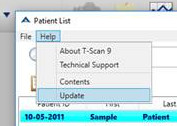
  1. Go to one of the T-Scan computers, open T-Scan, and click on "Help > Update" as shown below. If you don't see Update listed at the bottom of this menu and expect to have an upgrade pending, contact Technical Support.
  2. Follow the on-screen instructions, clicking Next on all screens to accept the default locations.
  3. Repeat steps 1-2 for additional operatory computers.

Download Instructions as PDF

Network Configuration

Use these steps to update T-Scan on workstations that share a networked database. Note: You must have purchased a Network License Add-on to enable this functionality. The first workstation you upgrade must be one that is currently using a networked T-Scan database for the database migration to be successful!

Each T-Scan application must point to the location where you placed your networked database. Since the location of the networked database will vary by dental practice, these instructions are a little more involved than the local configuration. We would remove these steps if we could!

Instructions

  1. Go to one of the T-Scan computers, open T-Scan, and click on "Help > Update" as shown below. If you don't see Update listed at the bottom of this menu and expect to have an upgrade pending, contact Technical Support.

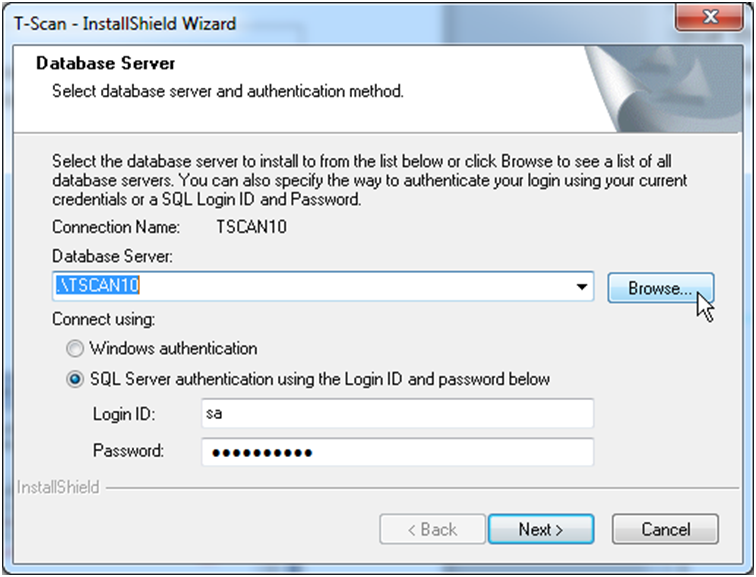
  2. Follow the on-screen instructions. When prompted to select the Database Server, click "Browse" and select the correct SQL Server/Instance name which was displayed in Step 5 when you installed SQL on your server.

  3. You should see the suffix "TSCAN10" as shown below. Then click "OK".
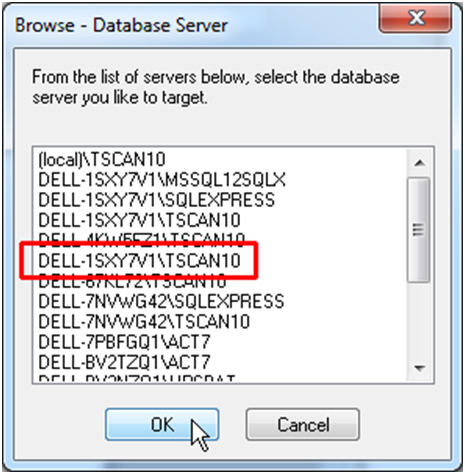
    Note: If no database servers are listed in this dialog, then you will need to type in the path "server_name\TSCAN10" manually and click next.

  4. Now that you have identified the database server, click "Next".

    Note: If you receive SQL errors, you will likely need to open a static TCP port in your server firewall for the TSCAN10 instance – click here for instructions.

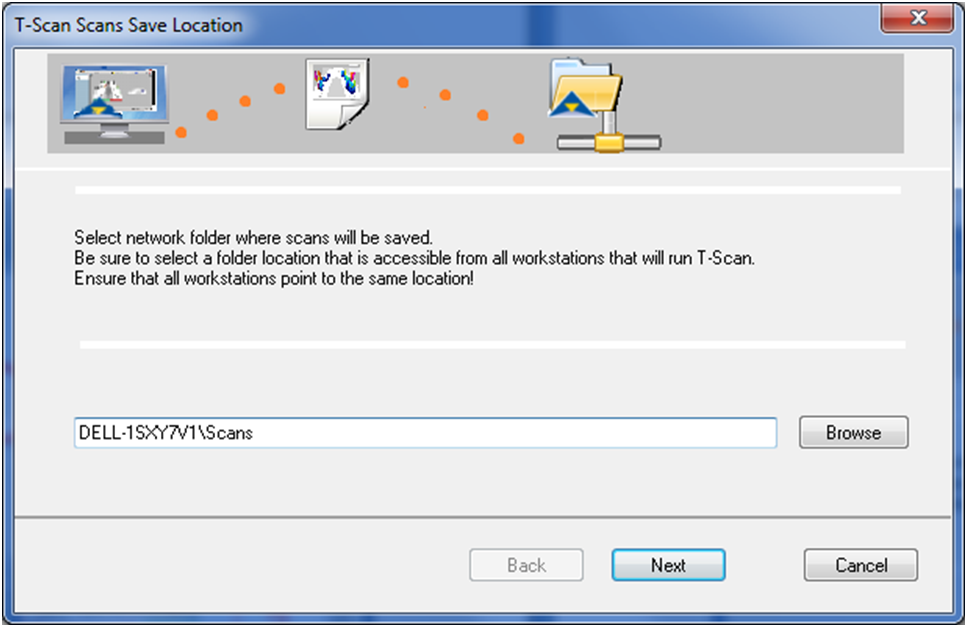
  5. When prompted to select where to save scans on the network, click "Browse" (or directly type the path). Point to the Scans folder on the database server you installed earlier (Step 5 of installing SQL. DELL-1SXY7V1\Scans in this example). Then click "Next".

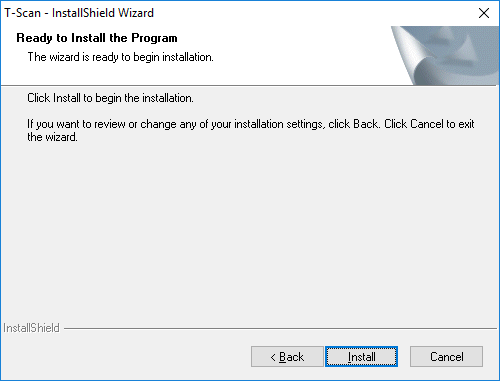
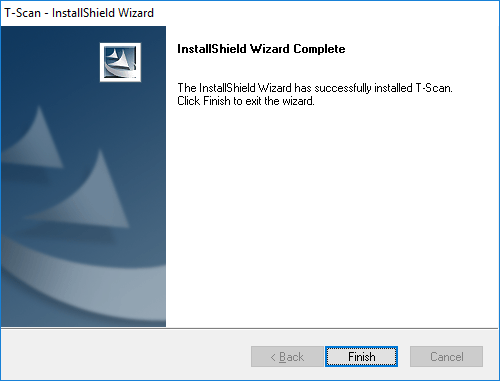
  6. Continue with the update process until the installation is finished.

  7. Repeat steps 1-6 for additional operatory computers, being sure to point to the correct Database and Scans locations in steps 4 & 5. All patient files should be accessible from that point forward.
  8. Double check on each operatory by opening the software, going to Help > Technical Support, and ensuring Database Location and Scans Save Folder are both pointing to the correct locations.

Download Instructions as PDF

Link to this FAQ

How to Open a Static TCP Port

If you have a Network License for T-Scan and the Browse dialog for selecting your networked database while updating T-Scan is empty, then you likely need to manually open a static TCP port in your Windows firewall to gain access to the networked T-Scan database.

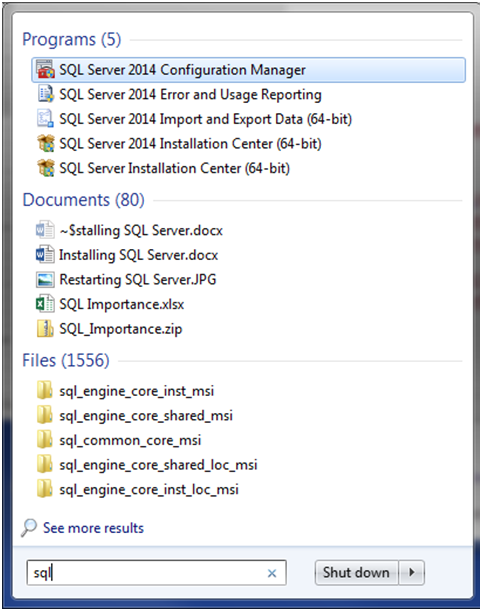
  1. Log into your server that is hosting the T-Scan database and open your server’s SQL Configuration Manager.
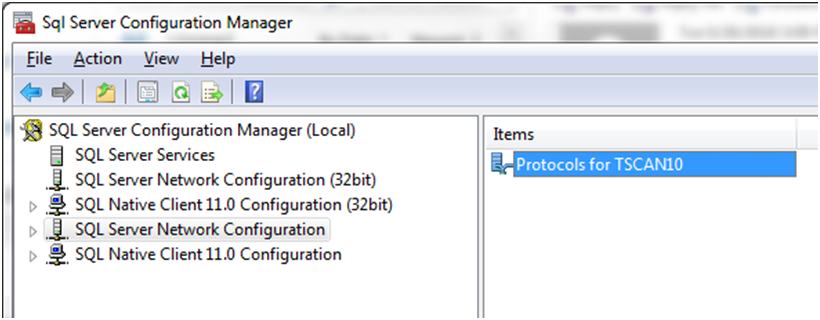
  2. Select "SQL Server Network Configuration" on the left and then double click on "Protocols for TSCAN10" on the right.
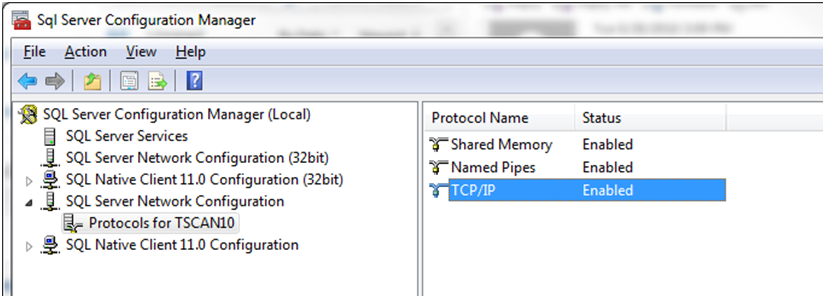
  3. Double click on "TCP/IP"
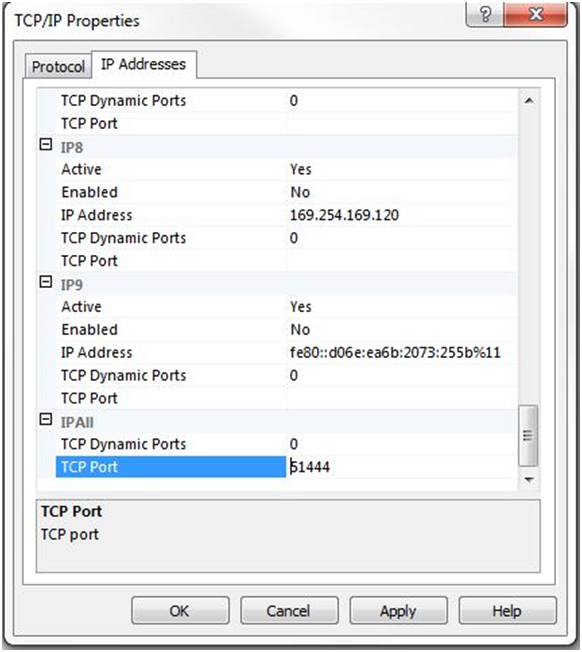
  4. Select the "IP Addresses" tab and scroll to the bottom. Set "TCP Dynamic Ports" to "0" and "TCP Port" to "51444" as shown below, then click Apply.
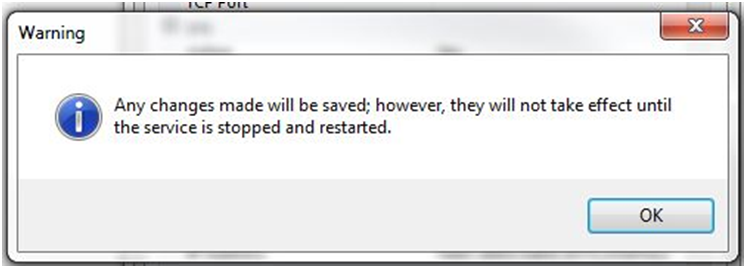
  5. Click OK when you receive the following warning.
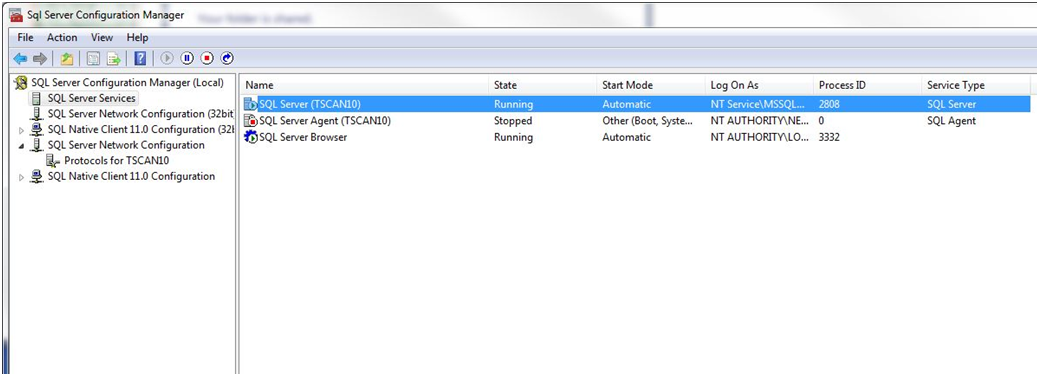
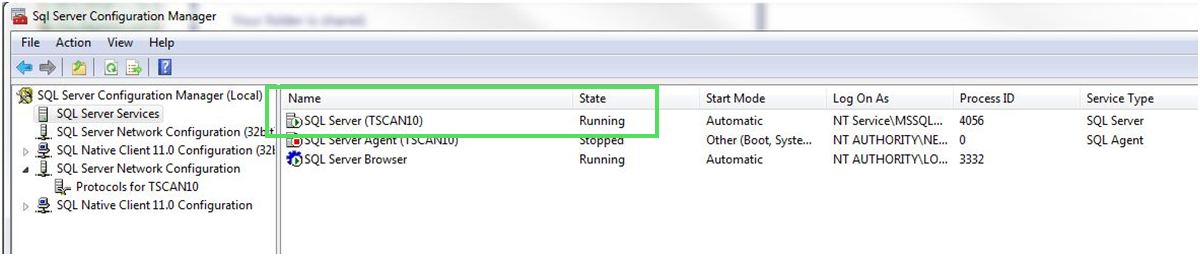
  6. Select "SQL Server Services" on the left and "SQL Server (TSCAN10)" on the right.
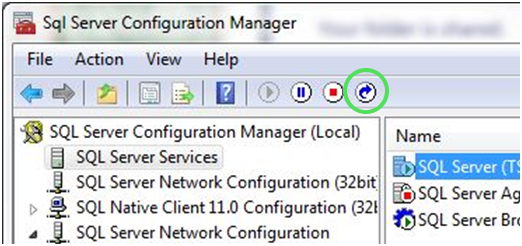
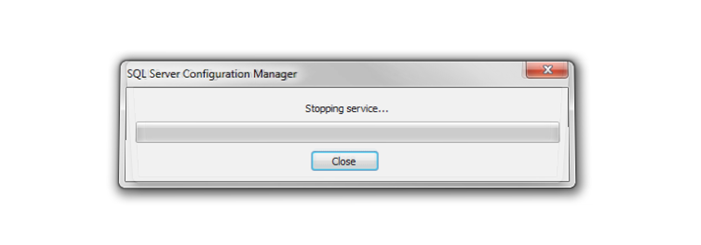
  7. Click on the Restart icon to stop and restart the SQL service.

  8. Verify that the SQL Service is restarted and running
  9. Return to operatory workstation and verify T-Scan can see the database on the network.

Download Instructions as PDF

Link to this FAQ

Unhandled Exception Error

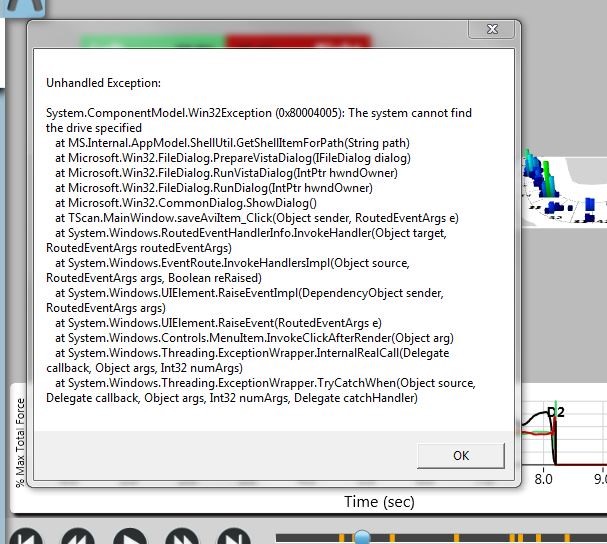
Problem: The following "Unhandled Exception" error comes up when the new T-Scan is started:


Solution:

  1. Plug in the USB handle and wait a few seconds, so the correct handle drivers are installed.
  2. Start the T-Scan software and confirm the above error is gone.
  3. Now it's OK to start T-Scan without the handle. It would not force an unhandled error, as the drivers are already installed.

Link to this FAQ